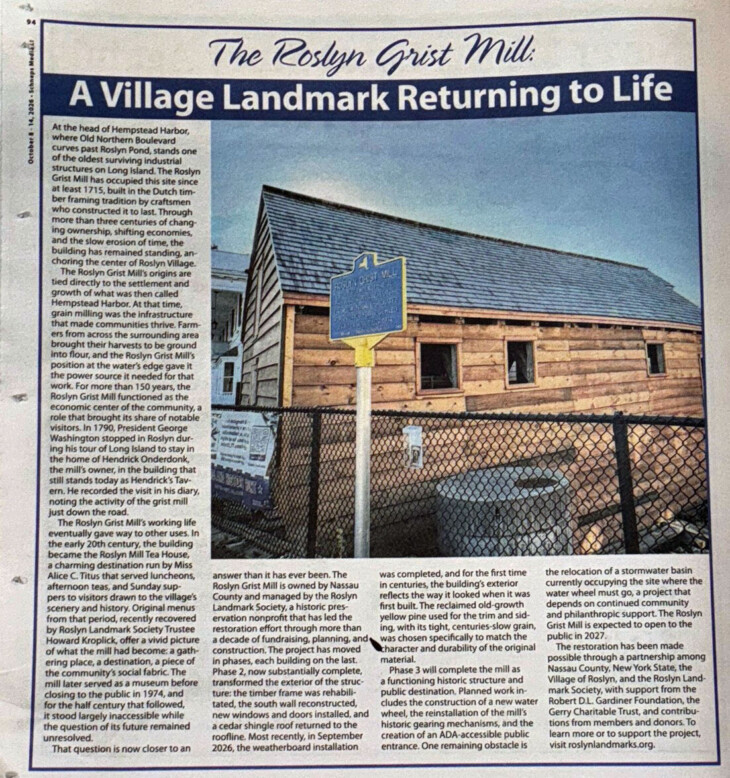
The Roslyn News Times published their annual Guide to Roslyn this past week, and featured the Roslyn Grist Mill as a village landmark that is "returning to life"! Read the text of the full article below:
At the head of Hempstead Harbor, where Old Northern Boulevard curves past Roslyn Pond, stands one of the oldest surviving industrial structures on Long Island. The Roslyn Grist Mill has occupied this site since at least 1715, built in the Dutch timber framing tradition by craftsmen who constructed it to last. Through more than three centuries of changing ownership, shifting economies, and the slow erosions of time, the building has remained standing, anchoring the center of Roslyn Village.
The Roslyn Grist Mill's origins are tied directly to the settlement and growth of what was then called Hempstead Harbor. At that time, grain milling was the infrastructure that made communities thrive. Farmers from across the surrounding area brought their harvests to be ground into flour, and the Roslyn Grist Mill's position at the water's edge gave it the power source it needed for that work. For more than 150 years, the Roslyn Grist Mill functioned as the economic center of the community, a role that brought its share of notable visitors. In 1790, President George Washington stopped in Roslyn during his tour of Long Island to stay in the home of Hendrick Onderdonk, the mill's owner, in the building that still stands today as Hendrick's Tavern. He recorded the visit in his diary, noting the activity of the grist mill just down the road.
The Roslyn Grist Mill's working life eventually gave way to other uses. In the early 20th century, the building became the Roslyn Mill Tea House, a charming destination run by Miss Alice C. Titus that served luncheons, afternoon teas, and Sunday suppers to visitors drawn to the village's scenery and history. Original menus from that period, recently recovered by Roslyn Landmark Society Trustee Howard Kroplick, offer a vivid picture of what the mill had become: a gathering place, a destination, a piece of the community's social fabric. The mill later served as a museum before closing to the public in 1974, and for the half century that followed, it stood largely inaccessible while the question of its future remained unresolved.
That question is now closer to an answer than it has ever been. The Roslyn Grist Mill is owned by Nassau County and managed by the Roslyn Landmark Society, a historic preservation nonprofit that has led the restoration effort through more than a decade of fundraising, planning, and construction. The project has moved in phases, each building on the last. Phase 2, now substantially complete, transformed the exterior of the structure: the timber frame was rehabilitated, the south wall reconstructed, new windows and doors installed, and a cedar shingle roof returned to the roofline. Most recently, in September 2026, the weatherboard installation was completed, and for the first time in centuries, the building's exterior reflects the way it looked when it was first built. The reclaimed old-growth yellow pine used for the trim and siding, with its tight, centuries-slow grain, was chosen specifically to match the character and durability of the original material.
Phase 3 will complete the mill as a functioning historic structure and public destination. Planned work includes the construction of a new water wheel, the reinstallation of the mill's historic gearing mechanisms, and the creation of an ADA-accessible public entrance. One remaining obstacle is the relocation of a stormwater basin currently occupying the site where the water wheel must go, a project that depends on continued community and philanthropic support. The Roslyn Grist Mill is expected to open to the public in 2027.
The restoration has been made possible through a partnership among Nassau County, New York State, the Village of Roslyn, and the Roslyn Landmark Society, with support from the Robert D.L. Gardiner Foundation, the Gerry Charitable Trust, and contributions from members and donors. To learn more or to support the project, visit roslynlandmarks.org.
0 Comments