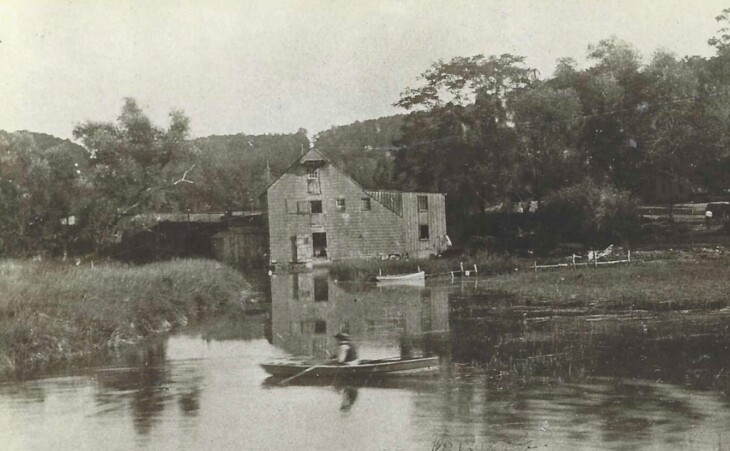
Image: Roslyn Grist Mill, undated. From the Collection of the Roslyn Landmark Society.
By Sydney Spier
Oftentimes when people are asked where the “Underground Railroad” was, they will immediately tell you that it was in the southern states of America. But contrary to this popular belief, the network continued far up North to New York and even on Long Island– including a possible stop at the Roslyn Grist Mill.
Established in the 18th century, the Underground Railroad was a network series of passageways, secret routes, and safe houses to help guide runaway Black enslaved people to freedom. As to how this system actually worked, a variety of people including white Quakers, farmers, abolitionists, and even formerly enslaved people worked together to help these runaways reach freedom. There was no specific “starting point” to the Underground Railroad as it ran through southern “Slave States” all the way up towards the north. The ultimate goal was to enable escape into either free northern states or Canada.
So, how did Roslyn become involved? From 1849 to 1916, the Grist Mill located in Old Northern Blvd in Roslyn was owned and operated by members of the Hicks Family, specifically Benjamin D. Hicks. The Hicks family shared a long history of aiding runaways. Benjamin's uncle, Robert Hicks, was known for leading fearless efforts in assisting runaways. He provided them with shelter, food, and a safe route out.
There were Underground Railroad stops located across Nassau County, mainly in Westbury and Jericho, but to ultimately escape, runaways likely would have had to sail out of the Long Island Sound and continue their travel up North. This may have led them to the Roslyn Grist Mill due to its strategic location at the head of Hempstead Harbor, flowing out into the Long Island Sound, and giving way to the Atlantic Ocean and a means to get to even further Northern destinations.
According to Professor Kathleen G. Velsor in her book, The Underground Railroad on Long Island: Friends in Freedom, it is possible that Benjamin Hicks and local Quakers assisted the escapees by leading them at night to an awaiting boat behind the mill. During high tide, the boat could quietly set sail and carry these passengers across the Long Island Sound.
The Grist Mill was not the only spot in Roslyn that possibly helped out the Underground Railroad. It is conjectured that houses on Main Street may have had secret hideout rooms that runaways may have seeked shelter in prior to sailing out from the Grist Mill under cover of darkness. At different points in the Roslyn Grist Mill’s history it served as an operating water mill, a tea house, and may have even played a pivotal role in Long Island’s Underground Railroad- leaving it with an enduring significance to be recognized and honored.
Sydney Spier is a student at Roslyn High School and a Roslyn Landmark Society intern currently serving as the Society's "Young Historian,” in collaboration with Blank Slate (now Schneps) Media.
2 Comments
Excellent article and an important one. I heard Professor Velsor give a talk at the Landmark Society many years ago and still have the brochure she gave us with a map showing the Grist Mill in Roslyn.
I think Dr. Velsor identified the wrong Hicks business as an Underground Railroad stop. It's much more likely it was the Hicks lumber yard just north of the grist mill. It was a bigger operation and could have concealed people more likely than the grist mill could. Harrison Hunt, co-author of Long Island and the Civil War, and former RLS president.