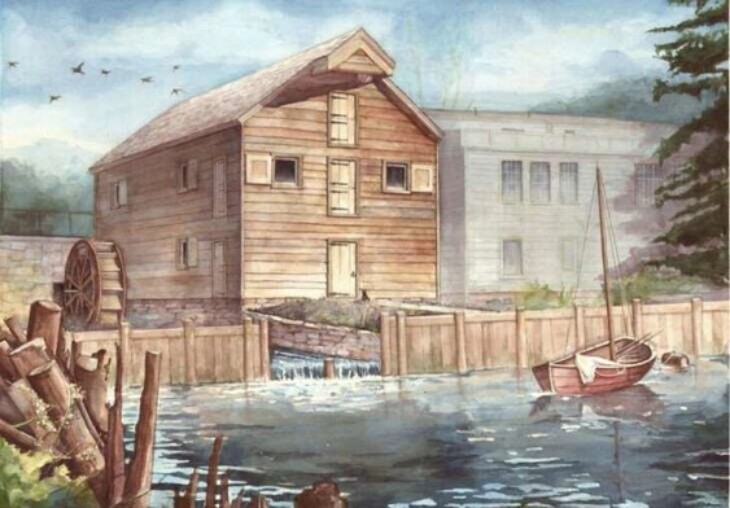
By Robyn Stanton
The Roslyn Grist Mill has been a key site in Roslyn for centuries. Beginning as a center for commercial activity and evolving into a historical landmark listed on the National Register of Historic Places, the Roslyn Grist Mill continues to captivate the attention of local residents and beyond.
As the year draws to a close and the Grist Mill continues to undergo crucial renovations to restore it to its original prowess, it appears timely to recall its beginnings through the efforts of one John Robison.
John Robison, whose name also appears as Robinson, Robeson, Roberson, and Robbinson, is first found in local documents in February 1691, when he is named in the North & South Hempstead Town Records. It would not be until seven years later when, on April 2, 1698, he was granted permission by the Town of Hempstead to establish a grist mill. Town Records indicate that the mill would be located at “ye streme att ye hed of the harboure,” at what is presently at the Head of Hempstead Harbor on Old Northern Boulevard in Roslyn Village.
The approval Robinson received was, however, obtained under the condition that the mill would be constructed and in operation within two years. Town Records indicate that by 1700, the anticipated deadline of the mill's opening had passed and the permission he was granted two years prior was then considered to be void at a Town Meeting held on April 1, 1701.
Curiously, five years later, Town Records note the presence of a road leading from Robison’s Mill Dam, revealing that despite the negation of Robison’s original agreement, he did indeed fulfil his commitment to build a grist mill at the site. In doing so, he would lay the foundation for what has been so aptly termed “a pivotal moment in Roslyn’s history.”
Arguably, it was Robison’s mill which helped to foster the growth and expansion of the Village of Roslyn as a core feature of its commercial economy. By the close of the decade, the Mill had left Robison’s hands as he and his sons, Joseph and John Jr., sold the property to Charles Mott for £100 on May 2, 1709. According to one source, Robison gave onto Mott, by deed, “one Sartain grist Mill w’t ye dam and streem upon ye head of Hempstead harbour as it was granted to us by ye Towne of Hempstead, a small frame of a hous and one Irn Crow w’t some other Instruments.” This would be the first of numerous transfers the Roslyn Grist Mill would experience in its lifetime as it continued to exchange hands over the centuries.
As ownership of the Roslyn Grist Mill has changed since its emergence at the dawn of the eighteenth century, its position as a key feature in Roslyn’s landscape and history remains unyielding. While it formerly ceased operating as an active mill in the early twentieth century, Robison’s efforts are not lost upon those concerned with the preservation of Roslyn’s history. The restored grist mill is anticipated to open as a public history educational center operated by the Roslyn Landmark Society in 2027.
Robyn Stanton is a doctoral candidate at Stony Brook University in the PhD History program and a current Roslyn Landmark Society intern.

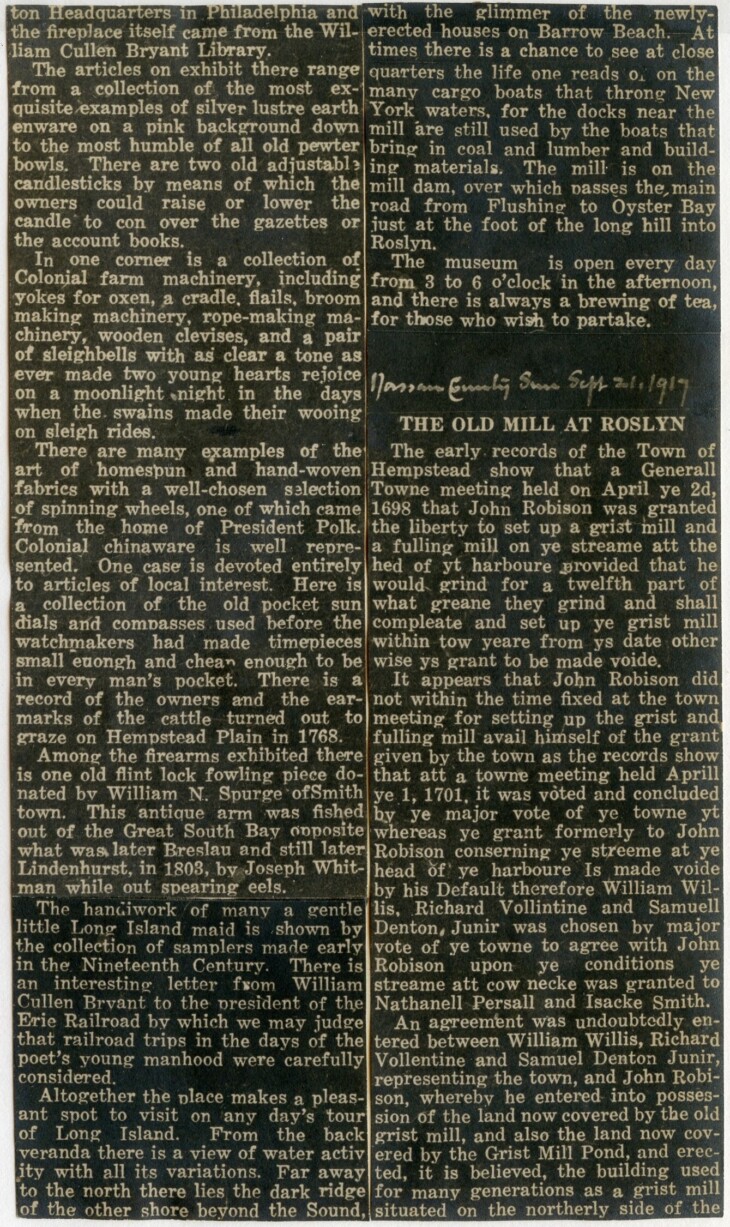
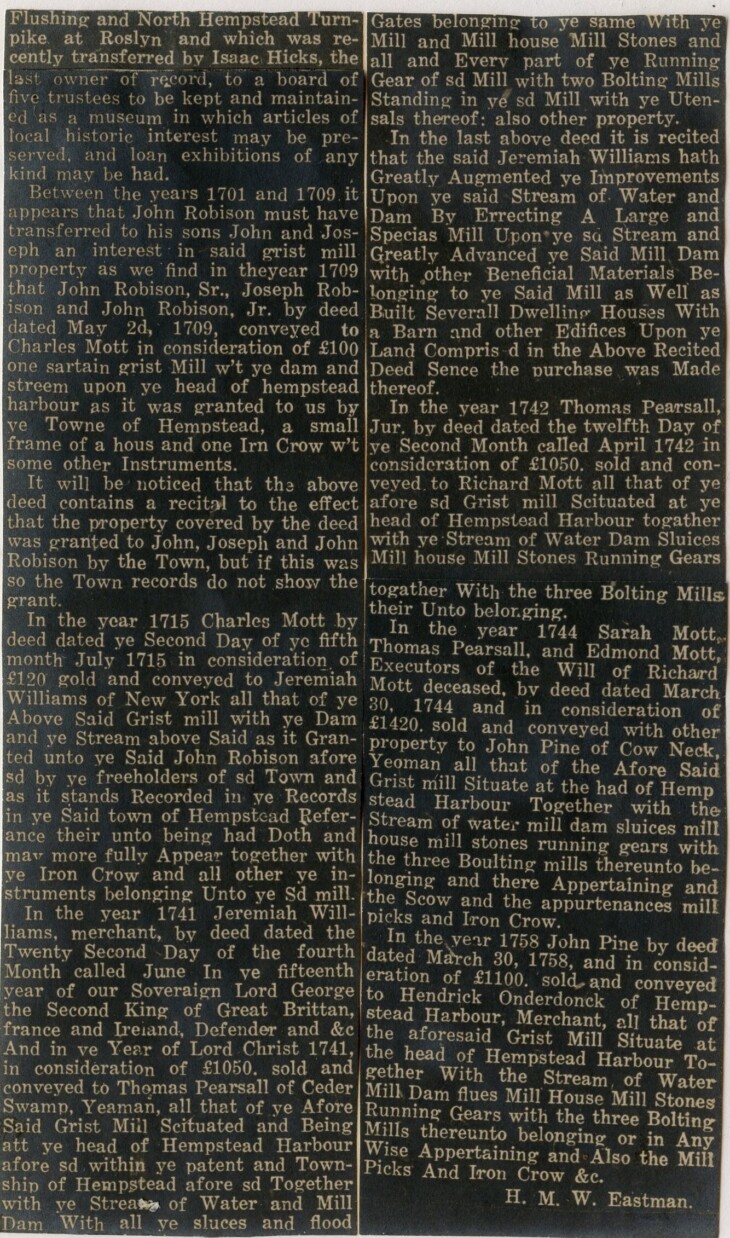
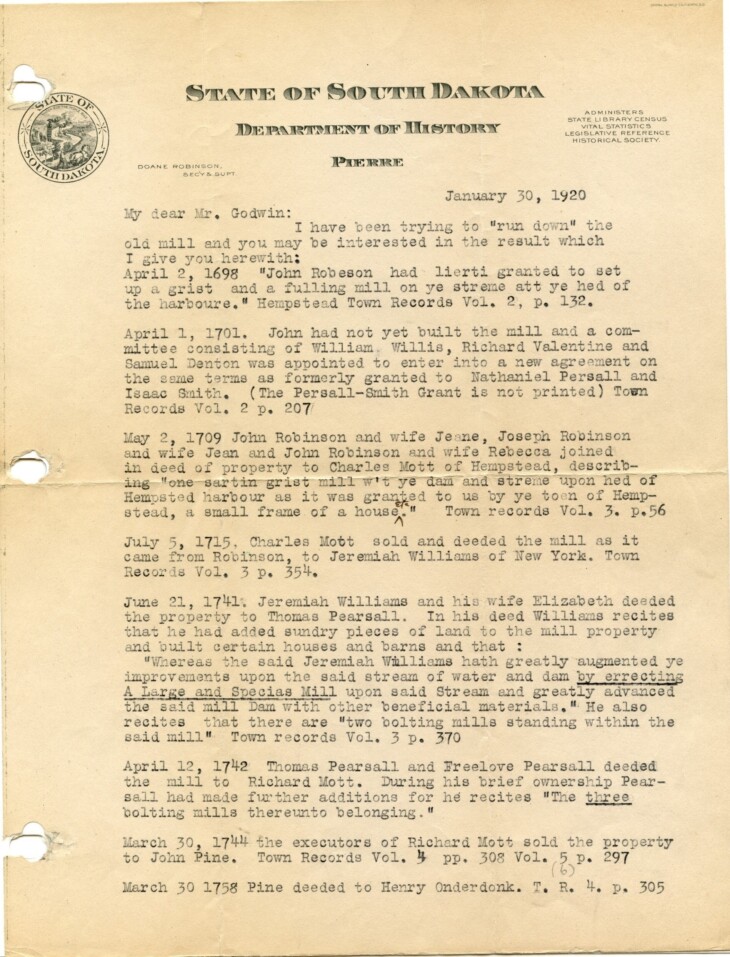
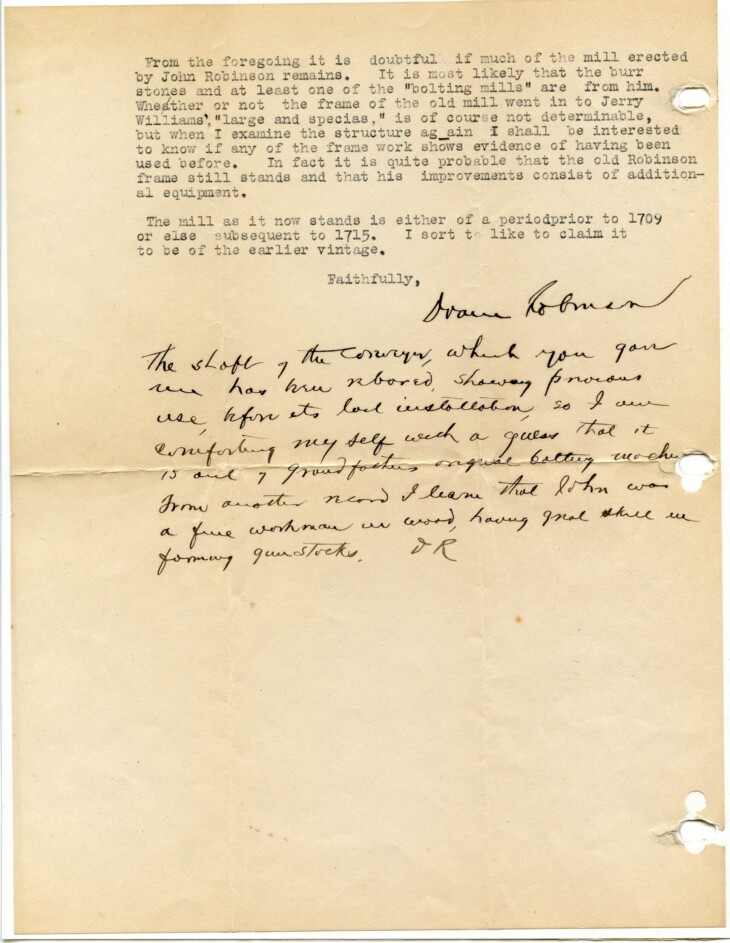
Images courtesy of Professor Tim Bestor, an 11th generation direct descendant of John Robinson.
1 Comments
fascinating documents--is the mill older than the usual date of 1715? And in Bryant's grandson, Harold Goodwin's time, circa 1916, that its purpose was a museum, with some impressive artifacts--do they still exist? And this history indicates it should when completed again become a museum for Roslyn.