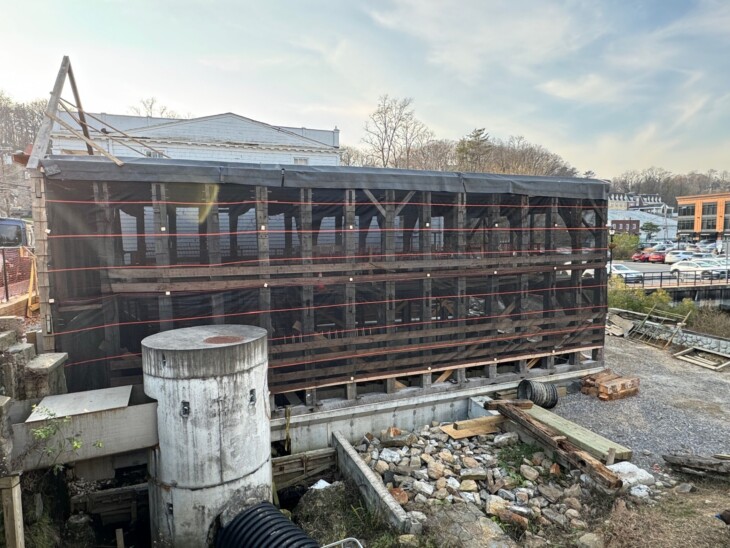
History of the Roslyn Grist Mill
The Roslyn Grist Mill is a rare surviving Dutch-framed watermill located at the head of Hempstead Harbor on Old Northern Boulevard in the Village of Roslyn. Listed on the National Register of Historic Places, it is one of few remaining grist mills in the New York metropolitan area and possesses a unique and extraordinary history worth preserving.
In 1698, John Robeson was granted permission to establish a grist and fulling mill on the site of the present mill at the head of Hempstead Harbor. While the 1698 agreement was later made void by Robeson's default, he went on to build "Robison's Mill Dam" on the site between 1701 and 1709. In 1709, he and his son, Joseph, sold the mill. Between 1715 and 1741, it was rebuilt and expanded.
Purposely built for industrial use, the grist mill in Roslyn was the first commercial building established in the community and served as the economic heart of the village as it grew and expanded for over one hundred and fifty years. President George Washington visited the site and met with its owner at the time, Hendrick Onderdonk, on April 24, 1790, during his grand tour of Long Island following the American Revolution. Washington even immortalized this visit in his diary.
As an essential commercial component in the settlement and development of the Village of Roslyn, the grist mill was owned and operated by several prominent local individuals over the many years it remained in operation. This included Benjamin D. Hicks, who owned the mill between 1887-1892.
In addition to being a member of one of Long Island’s earliest and most prominent families, Benjamin D. Hicks was also the leading advocate and force behind separating the Towns of Hempstead, North Hempstead, and Oyster Bay from Queens County. After thirty years of effort, Hicks finally saw his goal realized with the creation of Nassau County in 1899.
It was also under Hicks family ownership that, according to Professor Kathleen G. Velsor in her book The Underground Railroad on Long Island: Friends in Freedom, the Roslyn Grist Mill location served as a site used by the area’s Underground Railroad network. Local Quakers assisted runaway enslaved people escape to freedom by leading them under cover of darkness to boats waiting behind the mill. The boats would set sail at high tide to carry these passengers across the Long Island Sound, enabling them to continue their journeys north.
In 1916, the Hicks family sold the mill to a board of five trustees that included a grandson of William Cullen Bryant with the goal of turning the building into a museum. Following a brief period of restoration, the grist mill then served as a tea house and tourist attraction from 1920 to 1974. In 1976, ownership was transferred to Nassau County and new restoration plans were made.
Restoration progress
After forty-two years of delays and planning, the Roslyn Landmark Society stepped up and volunteered to undertake the immense challenge of restoring the Roslyn Grist Mill to its former glory. Between 2015 and 2024, the organization raised over $6.3 million for the restoration effort, securing awards and contributions from the Gerry Charitable Trust, New York State Office of Robert David Lion Gardiner Foundation, Nassau County, New York State Regional Economic Council, Save America’s Treasures, Professor Tim Bestor, a descendant of the family that built the original grist mill at the location in 1701, and members and sponsors of the Roslyn Landmark Society.
While the Roslyn Grist Mill is still owned by the county, the Roslyn Landmark Society now holds an inter-municipal agreement to improve, manage, maintain, and operate the mill as an education center. Since 2018, efforts have been steadily underway to restore the mill to both preserve it and make it accessible to the public.
An additional $1.95 million in funding has been allocated by Nassau County for the project, pending 2024 bonding approval. These funds will be used to complete the remainder of the restoration as well as assist in the development of the site into an education center. Active fundraising by the Roslyn Landmark Society is also underway and will continue until the end of the project.
The planned education center will contain historical exhibitions and host educational programming and events for the community. Upon total completion of the project, currently slated for 2027, the Roslyn Landmark Society will also hold a public ribbon cutting ceremony to celebrate the conclusion of the restoration and full opening of the site to the community.
Phases of restoration
Due to the extent and complexity of the renewal efforts involved, including the extensive funding required to complete such work, the restoration of the Roslyn Grist Mill has been divided into four phases.
Phase 1 of the project began in 2018 with stabilizing the building, creating a new concrete foundation, and removing the original timber frame for repair and conservation. As an initial step to build the new foundation, the structure was raised three and half feet above street level in 2020.
Construction on the new foundation began in August 2021 and was completed in November of that year. Although delayed due to the pandemic, the building was lowered onto its new foundation in July 2023 and is now fully supported by its timber frame.
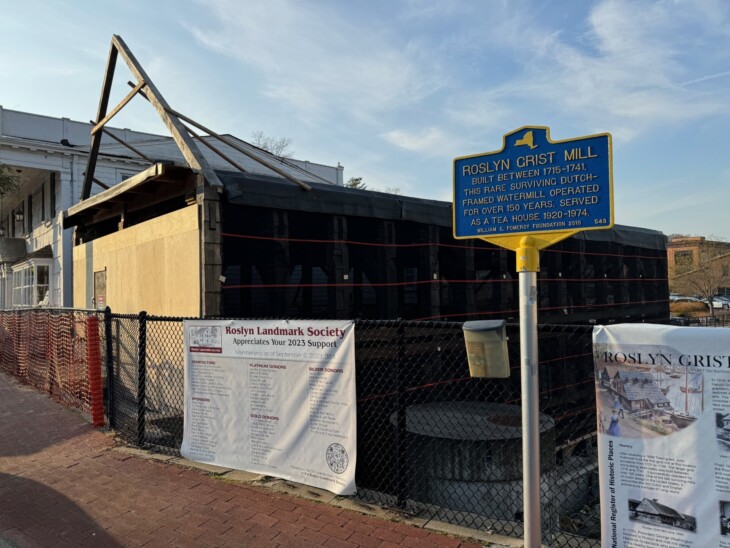
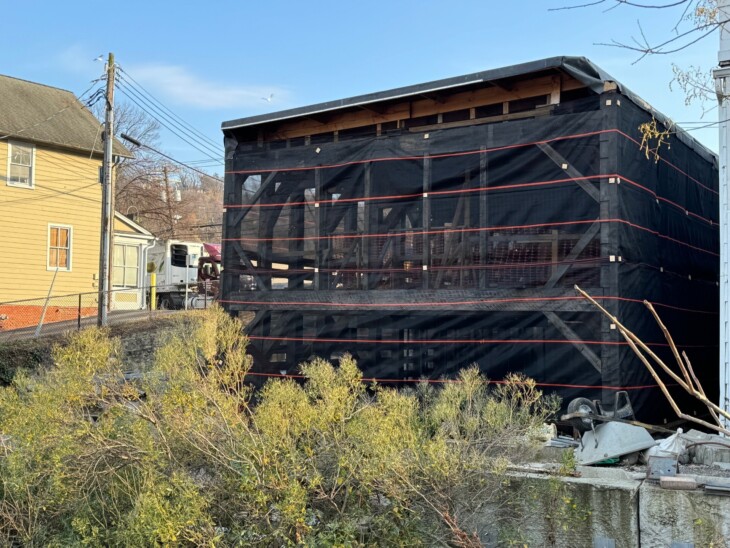
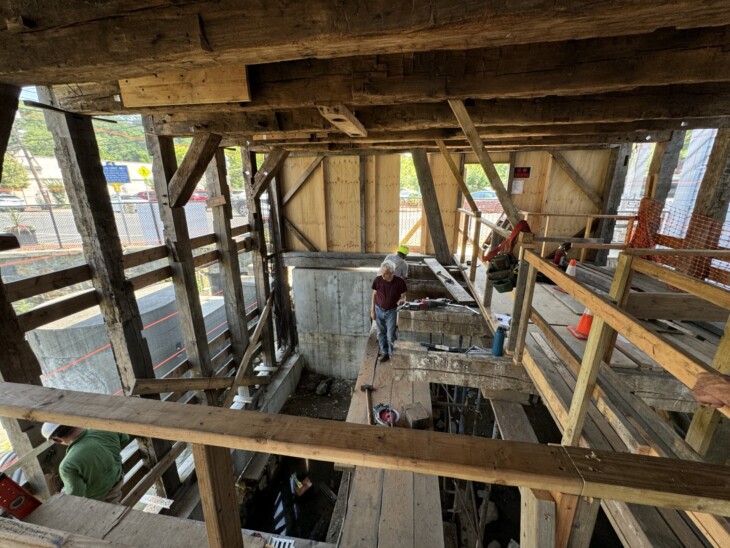
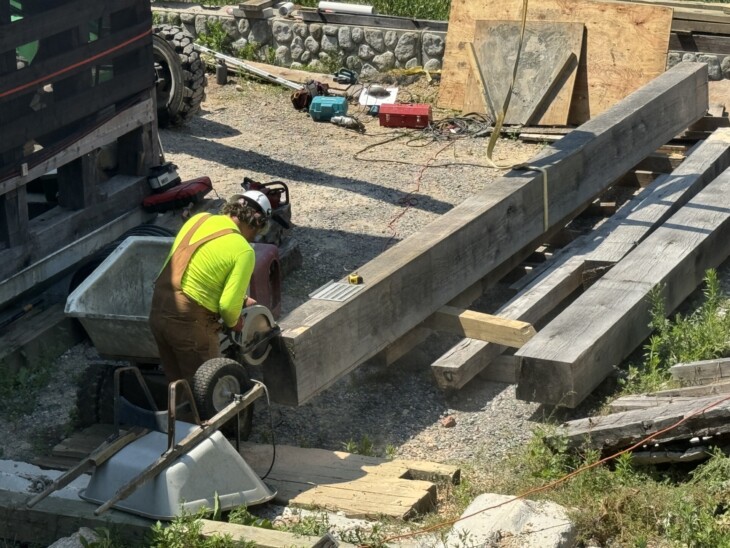
Phase 2 of the project began in September 2023, with the removal of the south wall and installation of timber framing and is projected to continue until mid-2025. Installation of the mill’s roof framing is scheduled to be complete by the end of this year, while the roof shingles, exterior siding, windows, doors, and interior flooring should be in place by spring. Limited public access to the Roslyn Grist Mill is currently projected to begin mid- 2025.
Phase 3 is anticipated to begin immediately afterward, with site work related to the repair and installation of the mill’s husk frame, gearing mechanisms, and new water wheel. This will be followed by the design and transformation of the space into a public education center that will serve as an attraction to the historic Village of Roslyn by providing STEAM-based learning opportunities related to the area’s extraordinary historical, industrial, and technological past.
Restoration team
In addition to the Roslyn Landmark Society’s Board Trustees and staff members involved with the Roslyn Grist Mill project, and due to the specialized nature of the labor involved, the organization also works with a select group of contractors with expertise in traditional building techniques and restoration of historic structures. Among these experts are a team of skilled timber-framers from Vermont and Massachusetts who have been dedicated to the project since 2015 and travel to Roslyn seasonally to complete the work required.
John G. Waite Associates (JGWA), the project’s historic preservation architectural firm, has been a part of the Roslyn Grist Mill’s restoration since 2004 with completion of initial feasibility and structural reports for Nassau County. This dedicated team of highly knowledgeable professionals has also completed work on numerous other notable historic buildings in the area, including Sagamore Hill National Historic Site and the historic Nassau County Courthouse.
Also dedicated to seeing the Roslyn Grist Mill project through to completion is Cole Company, the project’s construction management firm. Chris Cole and team have continually guided the Roslyn Landmark Society through the restoration to ensure all historic preservation guidelines are followed throughout the process.
Read this article on theisland360.com here.
0 Comments